.svg)



Medical Science Liaisons (MSLs) are one of pharma's biggest investments in scientific exchange. Yet many companies struggle to make every MSL interaction genuinely valuable to healthcare professionals.
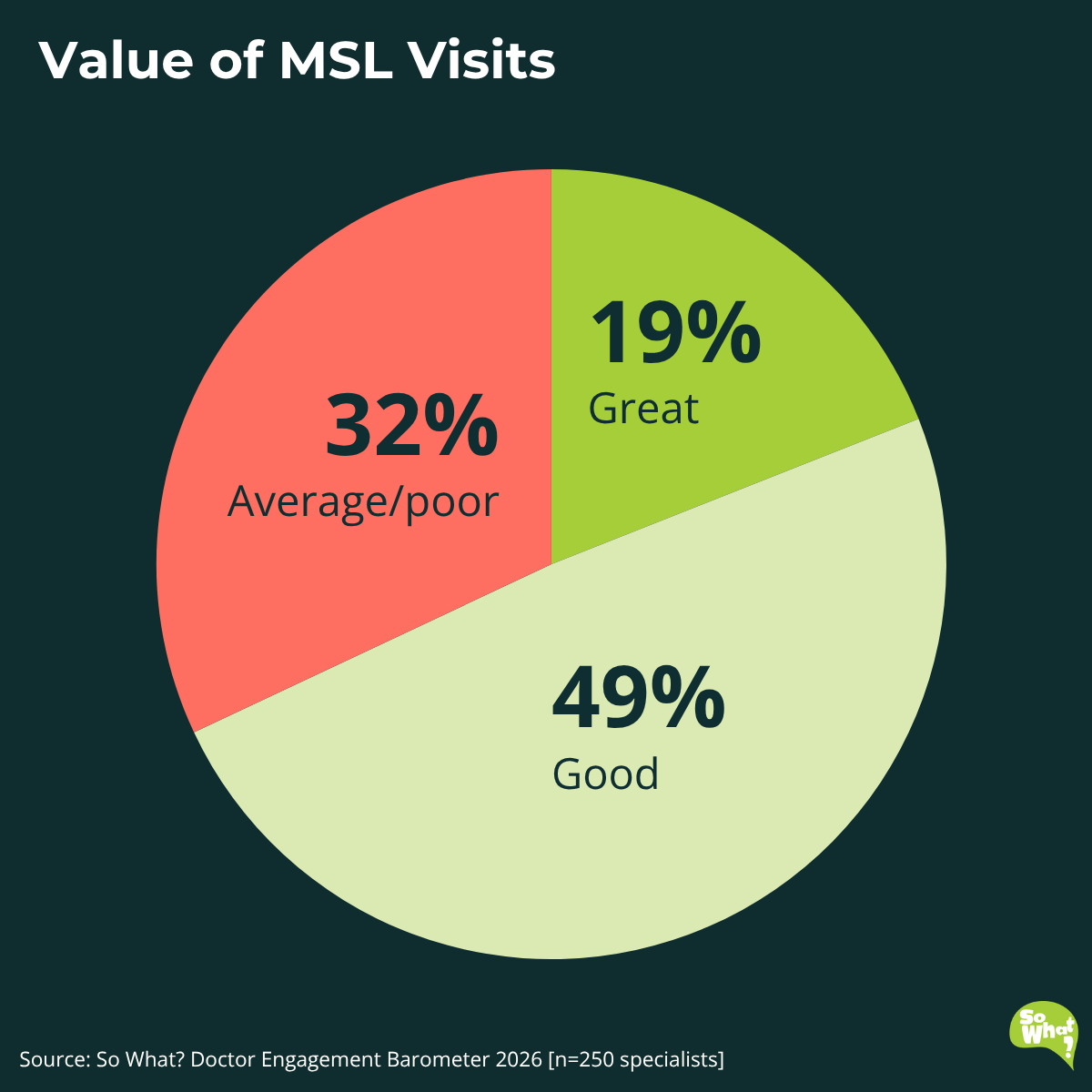
Our So What? Doctor Engagement Barometer, based on responses from 250 Australian specialists, reveals the gap. Only one in five specialists (19%) rate their MSL interactions as great. Almost half (49%) rate them as good, while 32% say they are average or poor. MSLs are valued, but there is a significant opportunity to turn good interactions into great ones.
The experience also differs sharply by specialty. The proportion rating their MSL interactions as good or great reaches 90% among medical oncologists but falls to around half in some other specialties. Demand for more MSL contact varies too.
So, what makes MSL engagement work, and where is there room to improve?
In this article, we explore:
Almost half of specialists (49%) rate their MSL interactions as good, but only 19% rate them as great. The challenge for pharma is to understand what lifts a positive interaction into one that specialists find genuinely valuable.
That opportunity differs by specialty. Good or great ratings reach 90% among medical oncologists but fall to around half in some other groups. The gap points to a need to understand what each group values from MSLs, rather than assume the same approach works everywhere.
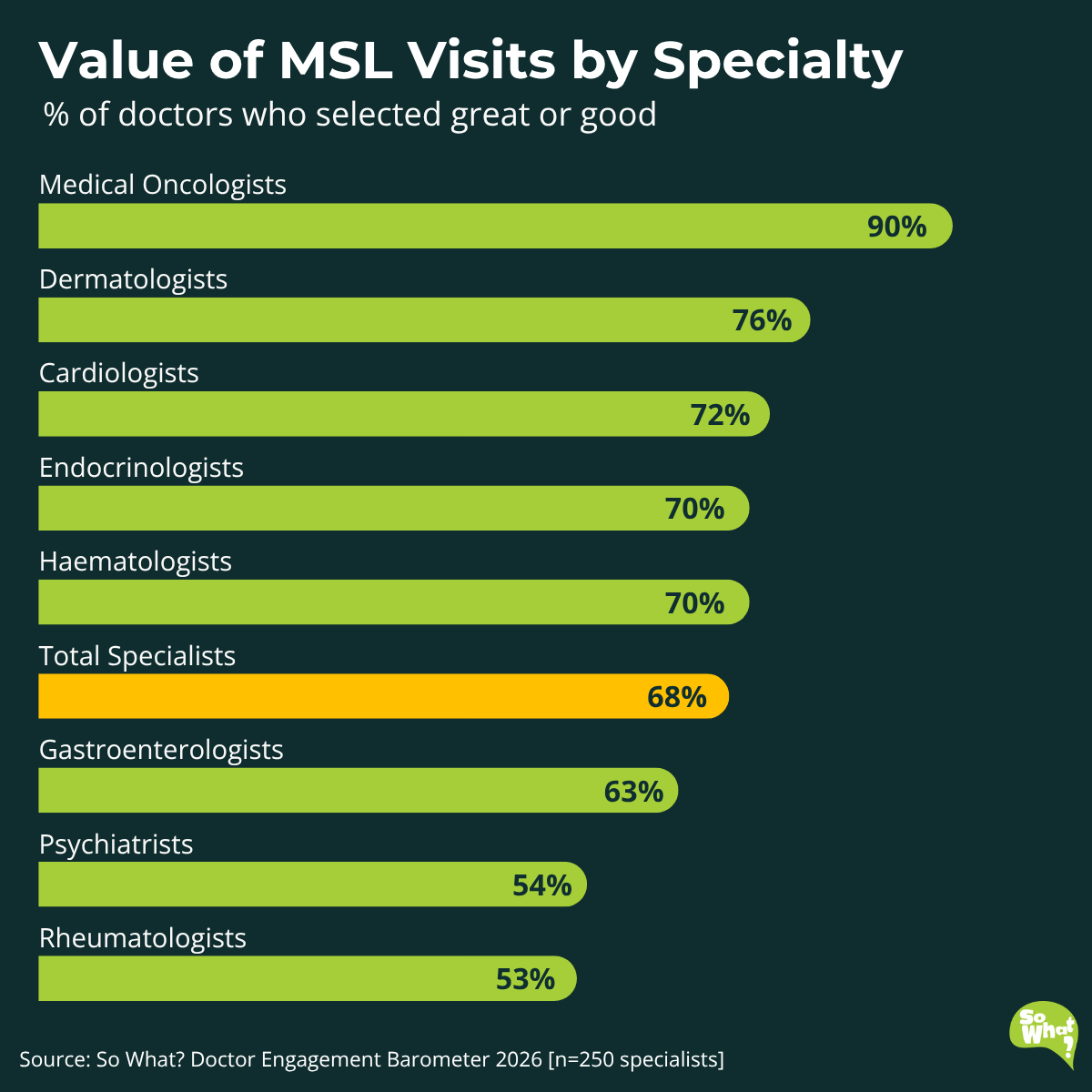
Most specialists (68%) rate their MSL interactions as good or great, and many would welcome more contact.
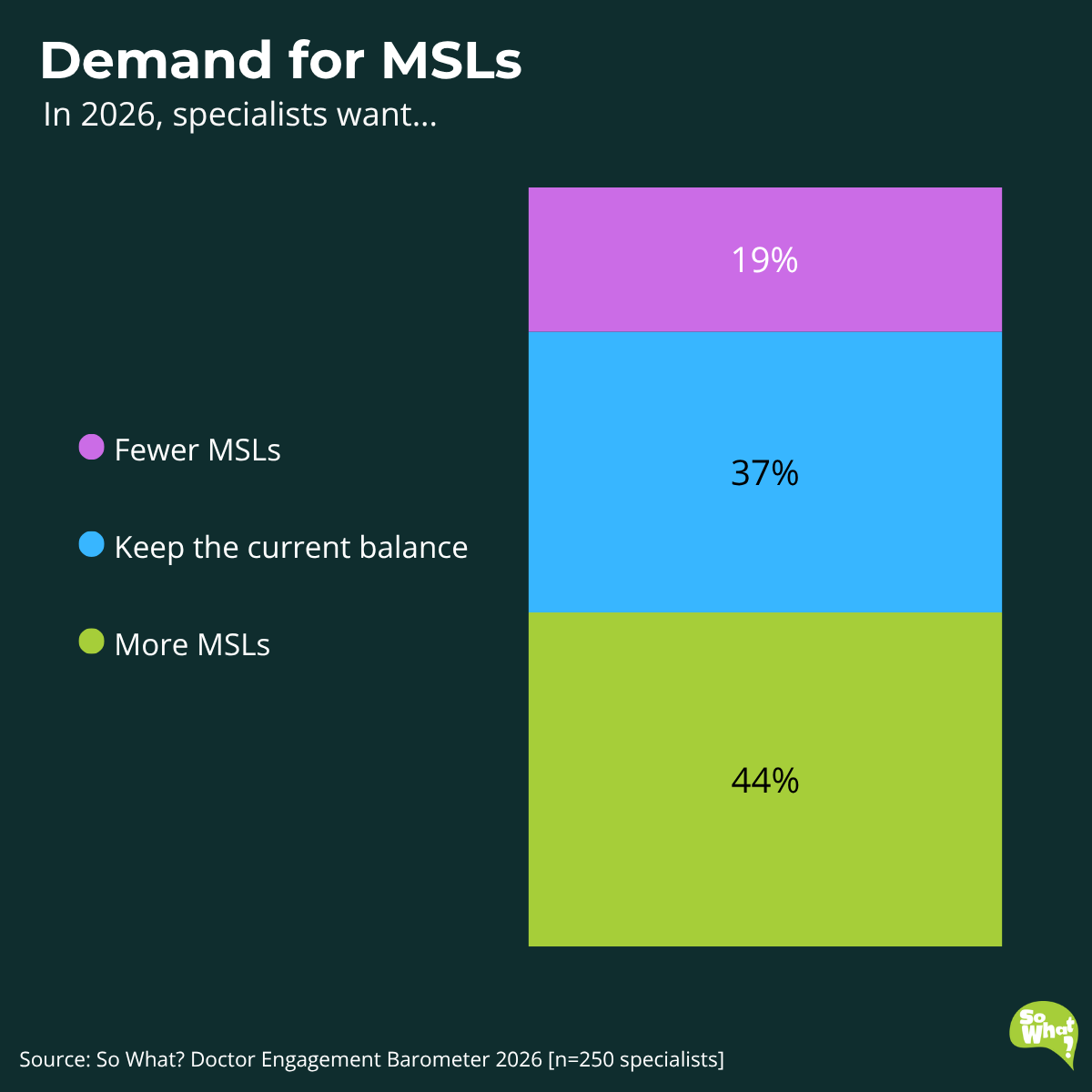
Nearly half (44%) want greater MSL presence, while a further 37% want current levels maintained. Together, that means more than eight in ten specialists want at least as much MSL contact as they have today.
Even as AI and digital channels expand, specialists continue to value direct access to MSLs. The opportunity is to make that contact consistently worthwhile.
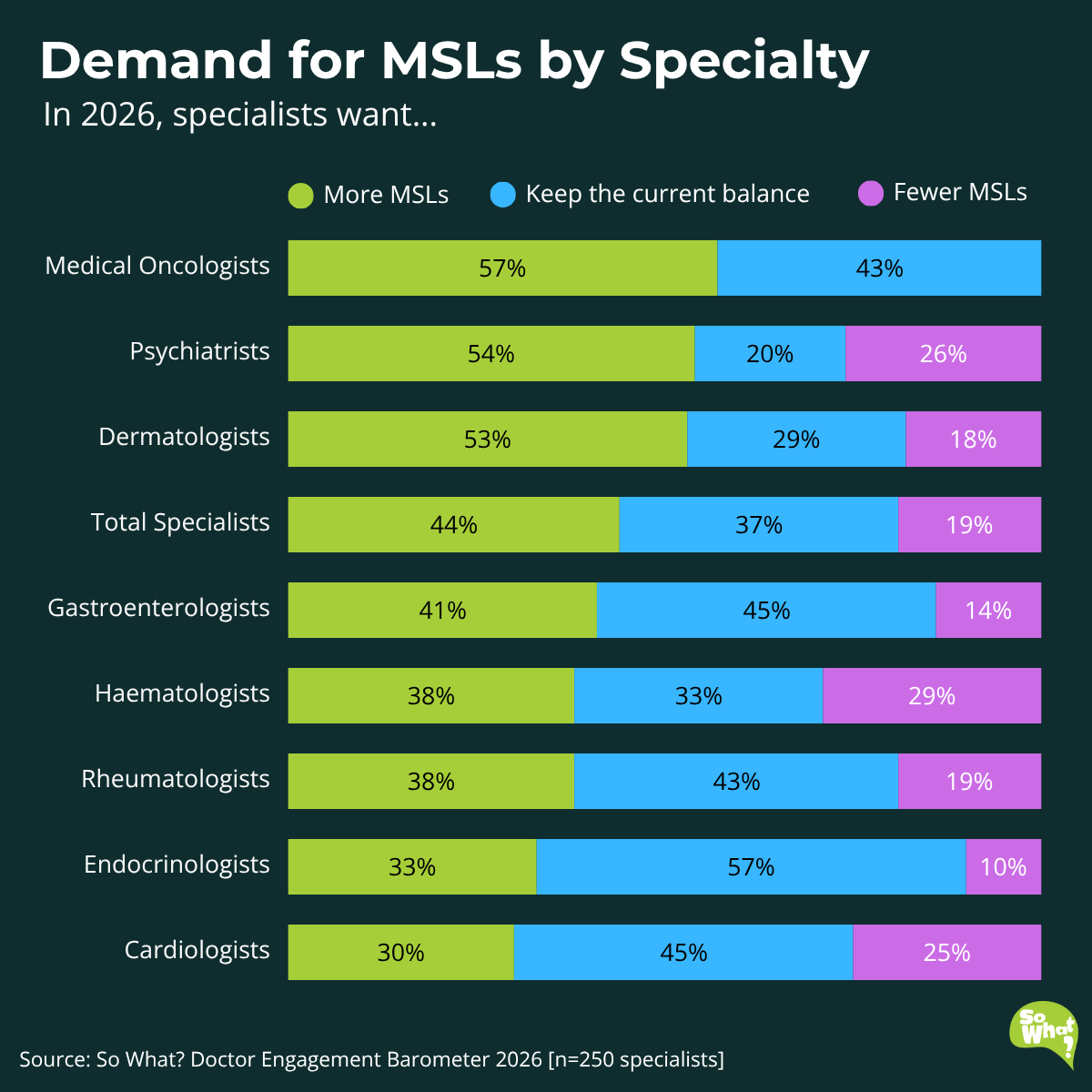
Looking at ratings and demand together reveals different needs across specialties. Medical oncologists give MSL interactions the highest positive rating (90%) and are the most likely to want more contact (57%). Psychiatrists also show strong demand for more (54%), yet their positive rating is among the lowest (54%). That suggests an opportunity to improve both access and the experience itself.
Cardiologists and endocrinologists rate their interactions positively (72% and 70%, respectively) but are the least likely to want more contact.
More is not automatically better. The opportunity is to know where specialists want greater MSL presence, and where making each interaction count matters most.
Across our data, three factors are strongly associated with how specialists rate their MSL interactions:
Differentiated: Is the MSL’s role clear and distinct from that of a product rep?
Helpful: Does the interaction help solve a clinical problem that matters?
Coordinated: Does the interaction feel part of one joined-up company experience?
Specialists rate MSL interactions more highly when they are differentiated, helpful and coordinated. A strong conversation can lose some of its value if the wider experience falls short.
The first factor, role clarity, emerged from our 2025 Barometer, where we saw a strong association between understanding the MSL role and perceived value.
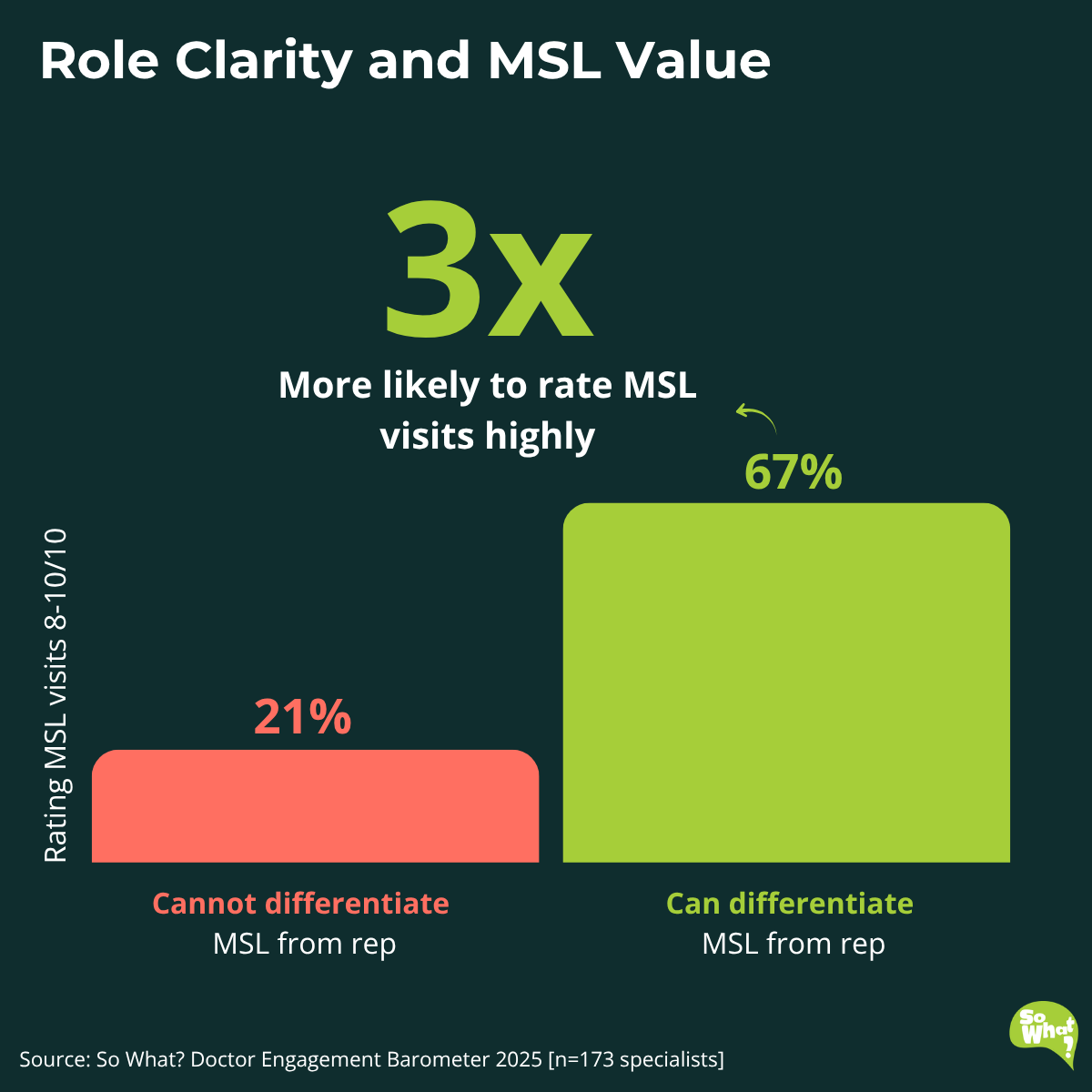
Almost one in three specialists (32%) cannot clearly distinguish an MSL from a product representative.
Among specialists who can distinguish the roles, 67% rate their MSL interactions as highly valuable. Among those who cannot, the figure falls to 21%.
Specialists who can distinguish MSLs from product representatives are more than three times as likely to rate their MSL interactions as highly valuable.
Being informative is not the same as being helpful.
While 90% of specialists say pharma provides useful information, only 61% say it helps solve clinical or workflow problems. That leaves a sizeable gap between sharing information and addressing the challenges specialists face in practice.
Helpfulness is also strongly associated with how specialists rate their MSL interactions.
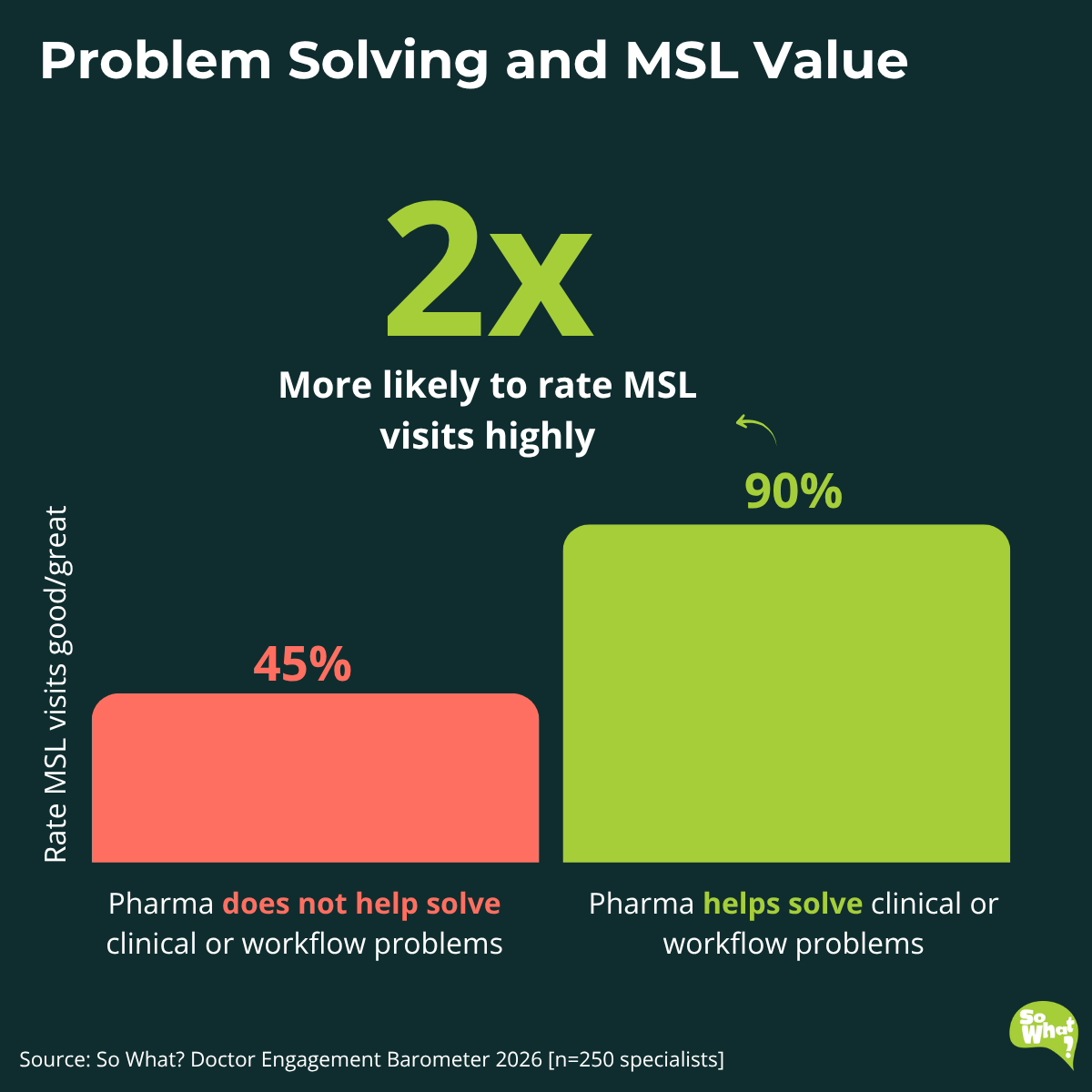
Specialists who see pharma as helpful in solving clinical or workflow problems are twice as likely to rate their MSL interactions positively.
For Field Medical teams, the question is not only what information they can share, but what problem the specialist is trying to solve. MSL conversations can help teams identify the support and resources doctors need most.
How specialists rate MSL interactions is closely linked to how coordinated their wider experience of pharma feels.
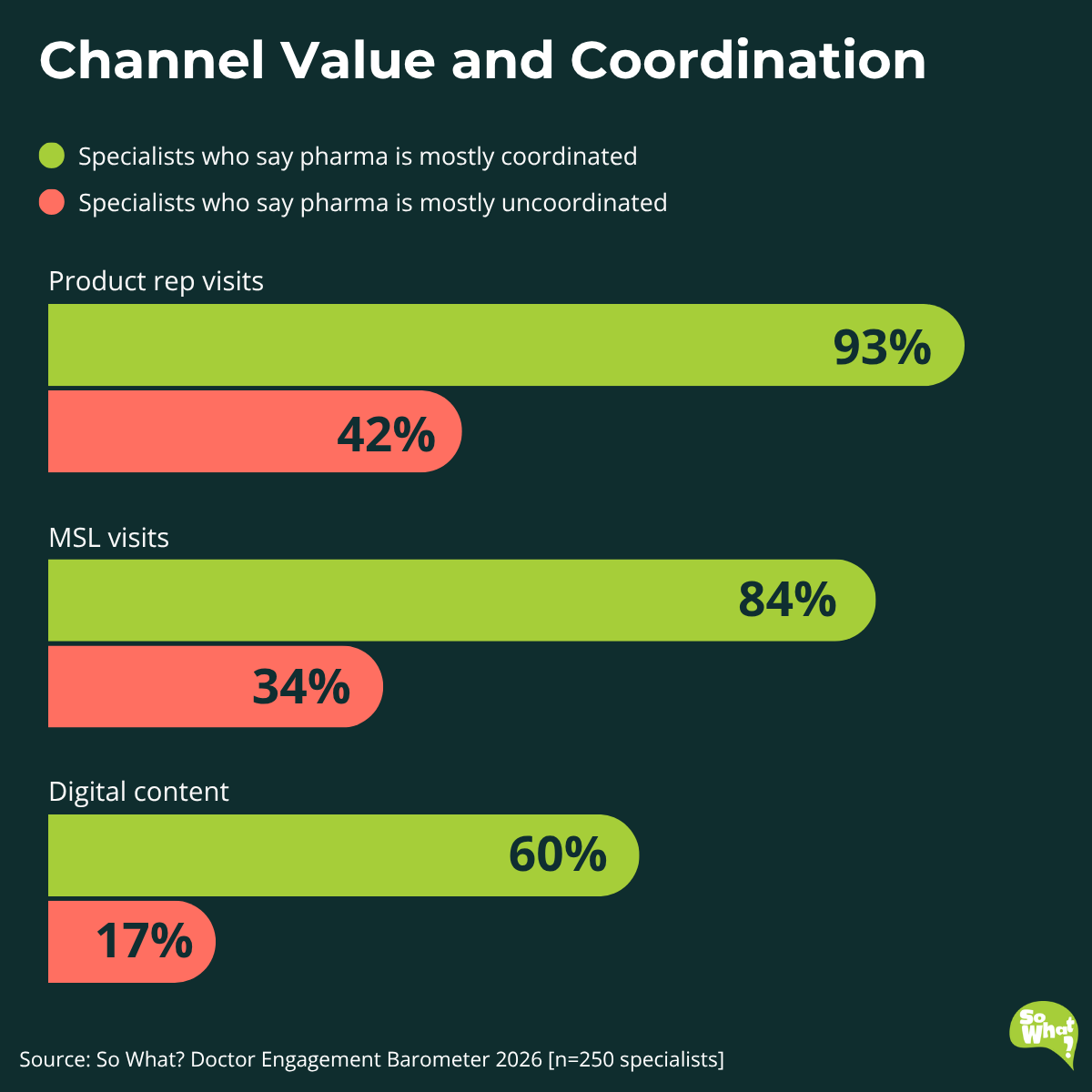
Among specialists who describe that experience as mostly coordinated, 84% rate their MSL interactions as good or great. Where it feels disconnected, only 34% do.
Specialists who experience coordinated pharma engagement are almost 2.5 times as likely to rate their MSL interactions as good or great.
The pattern extends across other channels. When engagement feels coordinated, 93% rate product representative visits as good or great and 60% rate digital content positively. Where it feels disconnected, those figures fall to 42% and 17%, respectively.
Coordination is associated with stronger ratings for MSLs, product representatives and digital content alike.
1. Good MSL engagement is not the same as great
More than two-thirds of specialists (68%) rate their MSL interactions as good or great, but only 19% choose great. The opportunity is to understand what would make more of those good interactions exceptional.
2. One MSL strategy will not fit every specialty
Both MSL value ratings and demand for more contact vary by specialty, and they do not always move together. Specialty-level insight can show where greater MSL presence is wanted and where improving existing interactions may matter more.
3. MSL value is bigger than the individual MSL
MSL value goes beyond the individual interaction. Role clarity, practical helpfulness and coordination across channels are all associated with higher MSL value ratings. Improving the experience takes work across the organisation, alongside the efforts of Field Medical.
Four moves to take into 2027 medical affairs planning:
1. Map value against demand by specialty
Where MSL interactions are highly rated and specialists want more contact, consider increasing presence. Where demand is high, but ratings are lower, investigate what needs to improve before expanding activity.
2. Make the role clear from the first meeting
Check whether your specialists can distinguish MSLs from product representatives. If the distinction is unclear, make the MSL’s purpose and contribution more visible.
3. Start with the specialist's problem
Shape conversations around the clinical or workflow challenges specialists face, as well as the evidence available to share. Use what MSLs learn to improve support across channels.
4. Measure great, not just good
Track the proportion of specialists who rate MSL interactions as great, alongside reach, frequency and the factors that shape their experience. This will show whether more activity is translating into greater value.
We help pharma teams understand how specialists experience MSL engagement, what they value most and where there is room to improve.
Our October article explores patient centricity: what doctors say good looks like, and where they feel pharma is falling short.
These insights come from The So What? Doctor Engagement Barometer 2026 - an independent national online study of n=500 Australian doctors including n=250 specialists across 20+ specialties. The research explores doctors’ experience with pharmaceutical companies. Data was from December 2025 to February 2026.