.svg)



Pharma teams are doing more than ever across reps, MSLs and digital. The question is not whether activity is happening, but whether it is adding real value for doctors. That value is often lost when pharma sits in silos and does not feel coordinated to doctors.
In the So What? Doctor Engagement Barometer 2026, we see that value lifts sharply when those touchpoints feel like they come from one team. When we split 500 Australian doctors by how coordinated their interactions with pharma feel across reps, MSLs and digital content, two very different realities emerge. Doctors who say pharma feels “mostly coordinated” are four times more likely to say their experience with pharma has improved over the past three to five years.
The same pattern shows up in how they rate channel value, the support they receive in practice, and the level of trust they place in information from pharma. Put simply, coordination shapes how doctors experience everything else.
In this article we explore:
We asked 500 Australian doctors a simple question: “When you interact with pharma companies across reps, MSLs, emails and digital content, how coordinated does it feel? Does it feel like one joined up team or more disconnected?”
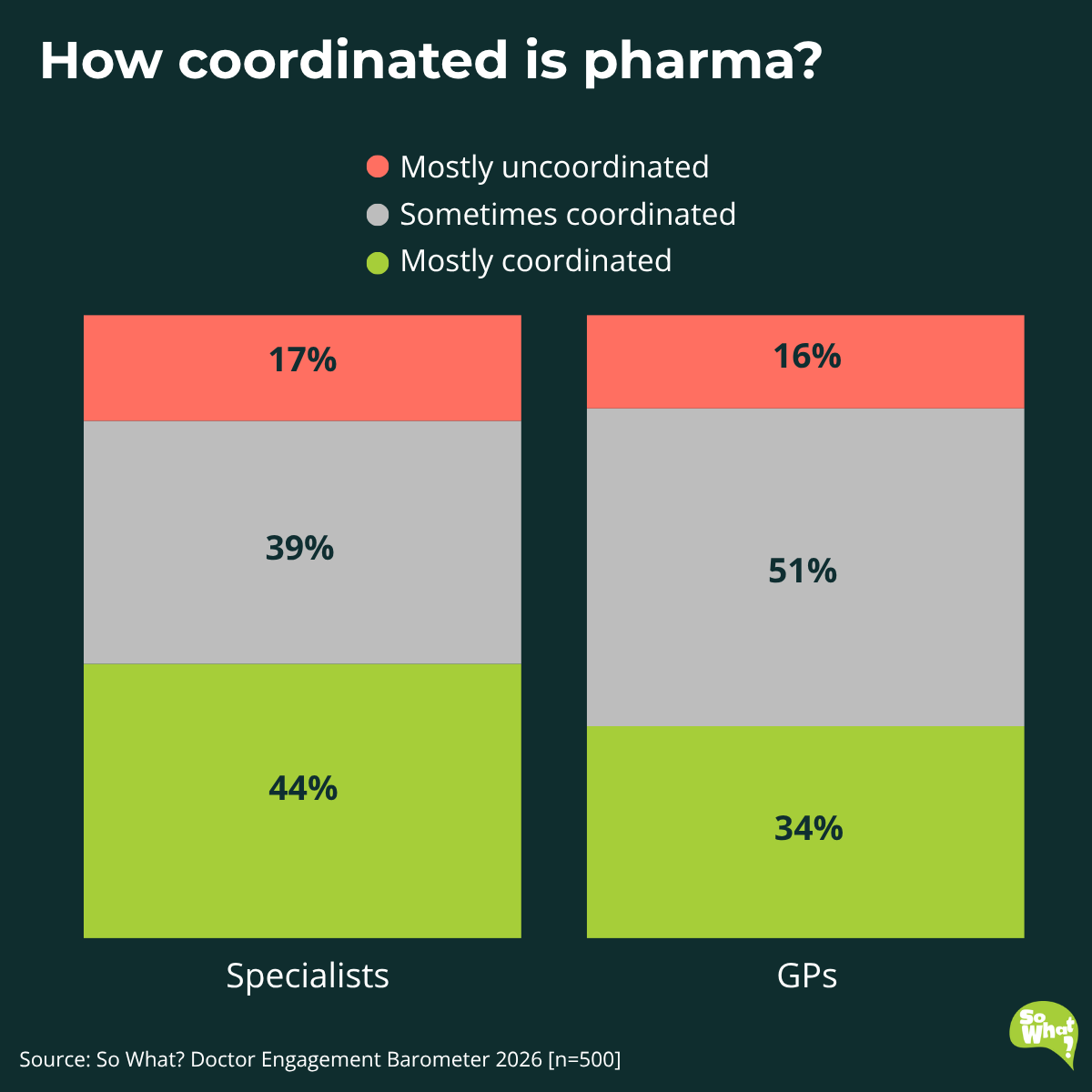
In our data we see 44% of specialists describe pharma as “mostly coordinated”, compared with 34% of GPs. GPs are more likely to sit in the “sometimes coordinated” middle ground, at 51% versus 39% of specialists.
The “sometimes coordinated” group is the tipping point. They are the doctors who can most readily move into the “mostly coordinated” camp when the experience feels more joined up.
Doctors value every channel and touchpoint more when it all feels coordinated.

When we compare channel value ratings between the coordinated and uncoordinated groups, the drop is consistent and steep:
The same activity delivers very different returns depending on how joined up it feels.
Coordination multiplies the value doctors get from each interaction.
Whether pharma shows up as one coordinated team or a set of disconnected pieces turns out to be crucial.

Doctors who say pharma feels mostly coordinated are far more positive on two fronts. They are around four times more likely to say their experience with pharma has improved over the last three to five years, and about five times more likely to say they trust the information they receive, compared with doctors who feel pharma is mostly uncoordinated.
The pattern extends beyond overall experience and trust. Across four areas of support including patient conversations, improved access, clinical decisions and reduced admin burden, the coordinated group consistently outscores the uncoordinated group by a clear margin.
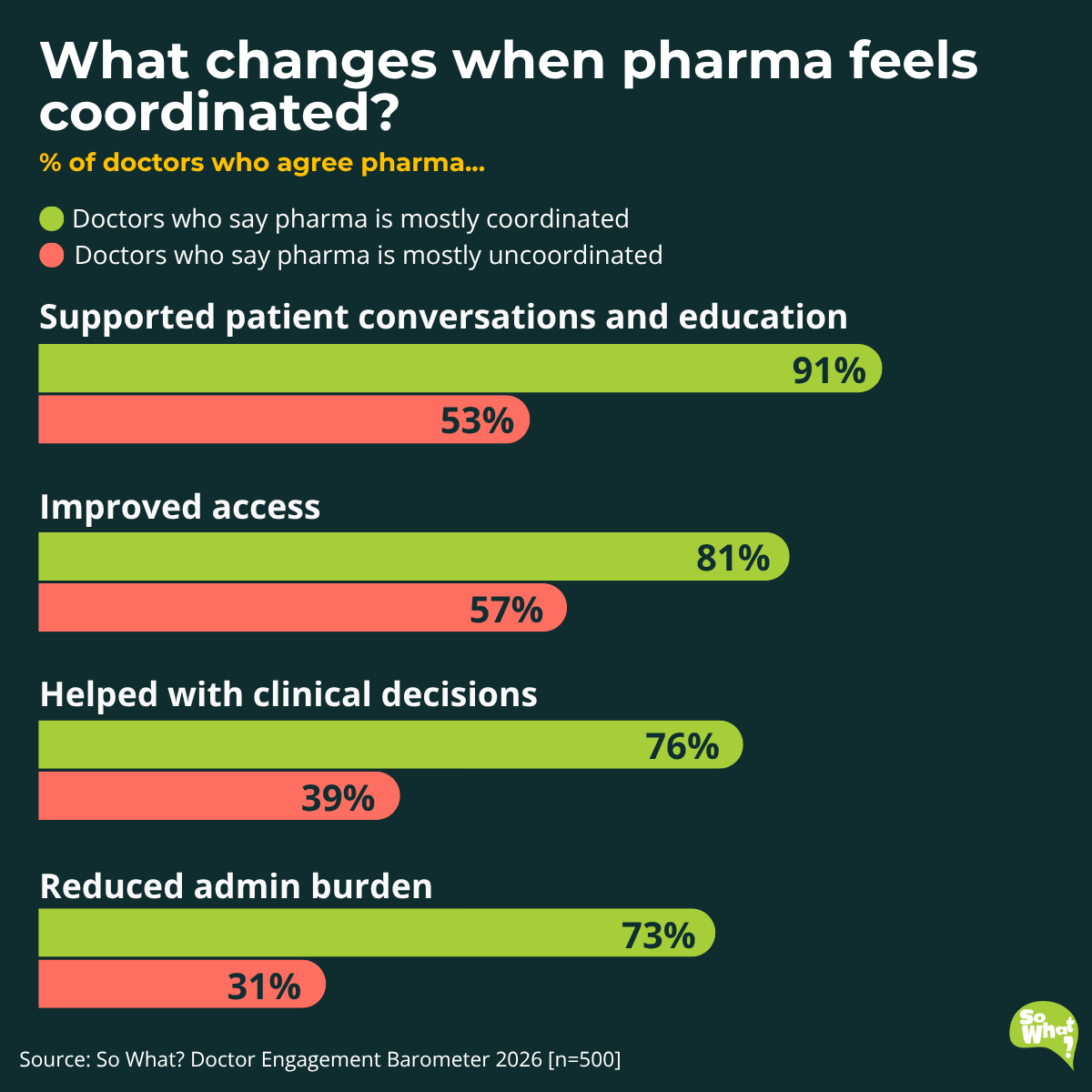
In practice, coordinated pharma makes it easier for doctors to treat patients and run their clinics.
Traditional metrics focus on activity and reach. Coordination tells you whether those interactions come together as a coherent experience for doctors. Without it, you cannot see if your field and digital investment is delivering full value or only part of it.
Three implications follow:
1. Your channel investment may be underperforming, and you would not know
When medical and commercial teams operate in silos, doctors pick up mixed messages and loosely linked contacts. That perception alone can significantly reduce the value they place on your channels.
2. Adding more activity won't close the gap
A busy but uncoordinated team will underperform a leaner, joined up one. The issue is not how much you do, but whether it feels like one team.
3. Uncoordinated doctors are a warning sign
Doctors who see you as mostly uncoordinated are much less likely to say their experience is improving. That is a sign the relationship is slipping and that they may disengage over time if nothing changes.
Three moves to bring coordination into your next planning cycle:
1. Find out where your brand sits
You cannot manage what you are not measuring. If perceived coordination is not currently tracked by specialty, that is the first gap to close.
2. Make coordination a core KPI
Add one question to your tracking: “Do doctors perceive my company as mostly coordinated?”
Track it for priority groups and discuss it alongside reach and frequency.
3. Redesign roles around a single story
Map how reps, MSLs and digital should work together so the doctor gets a clear, consistent story from everyone they see. Share and use that map internally.
The teams that act first will be the ones doctors describe as helpful, joined up partners who make practice easier.
These insights come from The So What? Doctor Engagement Barometer 2026 - an independent national online study of n=500 doctors (n=250 GPs and n=250 specialists across 20+ specialties). The research explores doctors’ experience with pharmaceutical companies. Data was from December 2025 to February 2026.