.svg)


Australian doctors are finding medical information with confidence. Nearly three in four (74%) say they always or often easily find the medical information they need when searching online or using AI.
When we asked 500 Australian doctors how pharma could better support their information needs, they pointed to stronger Medical Information support, easier access to reps, better website navigation, clearer evidence summaries and practical clinical guidance.
In this article, we explore:
For teams shaping their Medical Information, digital or AI strategy, the question is shifting from “Can doctors find our information?” to “Are we providing information they actually value?”
We asked 500 Australian doctors how easy it is to find medicine information online or through AI when they need it.

Nearly three in four doctors say they always or often find the medical information they need.
This pattern is consistent across GPs (76%) and specialists (72%), and across generations: Baby Boomers (77%), Gen X (73%), and Millennials (74%).
Discoverability is already working well, so being found is no longer the challenge, being useful is.
When doctors ranked where pharma should focus to better support their medical information needs, the top priorities were clear.
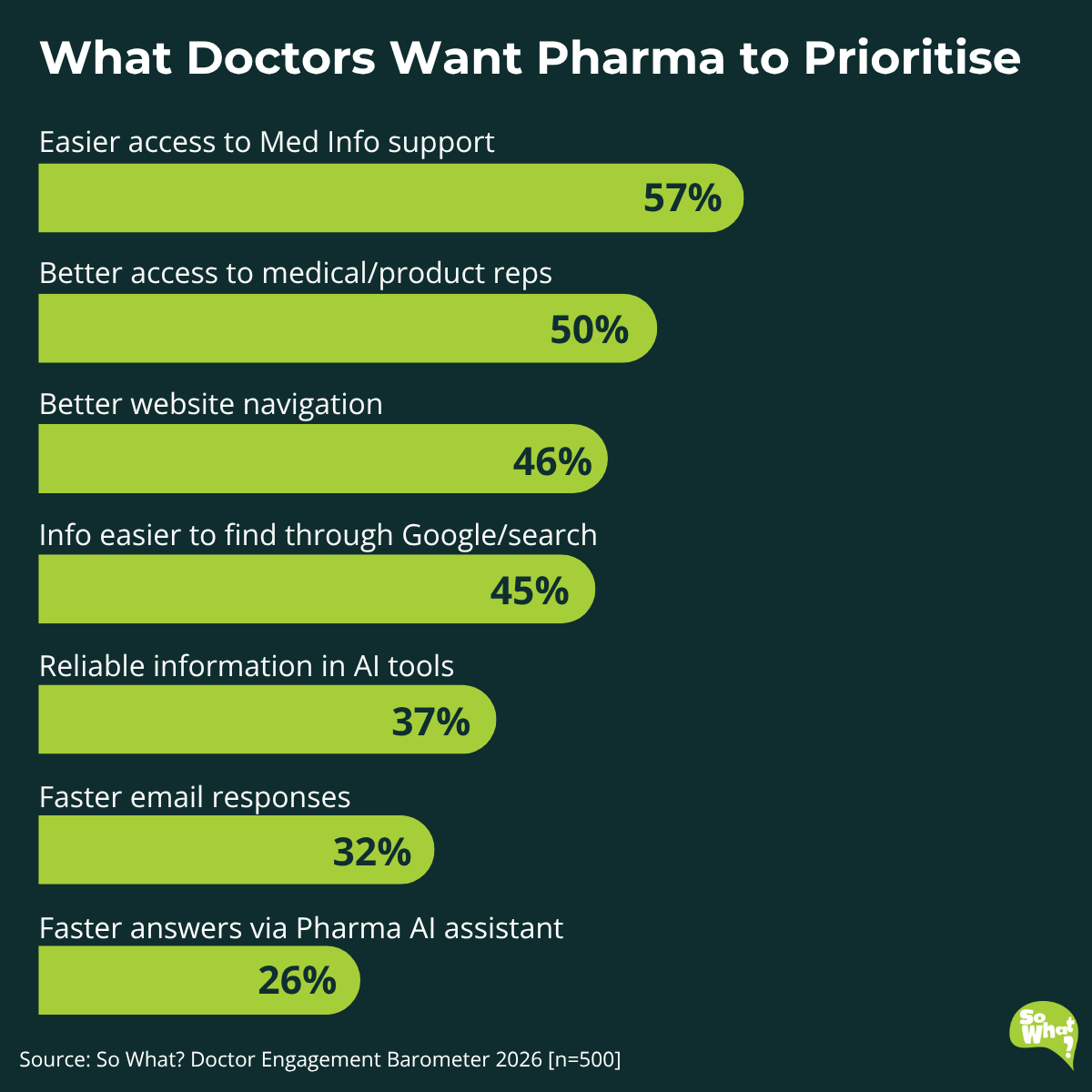
Easier access to Medical Information ranked first at 57%, followed by better access to medical or product reps (50%), better website navigation (46%) and easier findability through Google or search (45%).
AI-related options, such as reliable information in AI tools and fast answers through a pharma-provided AI assistant, sat lower on doctors’ list of priorities. More than one in three doctors (37%) still see value in AI, so it remains relevant. But the stronger message is:
Doctors want better human access and better findability through the channels they already use and trust.
AI-related options ranked lower in doctors’ priorities, which suggests two things are at play.
1. Channel familiarity
Doctors are already getting the information they need through familiar channels. When those channels are doing the job, the strongest opportunity is often to make them simpler, faster and easier to use.
2. Trust
Trust remains central. In a clinical setting, information must feel credible, clear and safe to act on. Trust in AI is still developing, especially when the information can influence prescribing or patient care.
Doctors aren’t rejecting AI, they’re waiting for it to earn clinical trust. The role of AI will grow as doctors build confidence in it as a trusted and practical source of information.
When asked what would make pharma’s digital or AI content more valuable, doctors prioritised information that helps them interpret evidence and use medicines confidently in practice.

Clear summaries of evidence ranked first, selected by 49% of doctors, closely followed by guidance on the safe use of medicines at 47%. Comparisons between treatments also featured strongly (40%), suggesting that doctors value content that helps them assess the available options - not simply understand an individual product.
Practical guidance was another recurring theme. More than one-third wanted clearer advice on what to do next, while access, reimbursement and PBS information was selected by 34%. Together, these findings suggest that valuable content must do more than provide information: it should reduce complexity and help doctors make or implement clinical decisions.
Patient-specific information and treatment sequencing ranked lower. This likely reflects how difficult it is to deliver that kind of tailored guidance through general digital content.
Doctors place the most value on content that makes evidence easier to interpret and apply in practice.
Most doctors can already find medical information when they need it. What matters more now is the quality of that experience and whether the information is useful, trusted and easy to apply in practice.
That helps explain why Medical Information support, rep access and findability rank ahead of AI-related options. Doctors still see value in AI, but their strongest priorities remain practical support and content that helps them make confident clinical decisions.
For pharma, the opportunity sits in making information easier to access, easier to use and more valuable in the moments that matter.
These findings give pharma teams a useful prompt for their next planning conversation.
1. Review where you are investing
Compare your current investment across Medical Information, field engagement, digital channels and AI. Does it reflect what doctors are asking for most clearly?
2. Look at content through a clinical lens
Review whether your content helps doctors interpret evidence, use medicines safely and make practical decisions. Information alone is less valuable than information that can be applied with confidence.
3. Test the experience end to end
Check how easy it is for doctors to find information, navigate your website, contact Medical Information and receive a useful response. Small points of friction can shape the overall experience.
4. Assess trust, not just visibility
Reach matters, but so does confidence. Consider how you are measuring whether doctors find your information credible, useful and easy to act on in practice.
These findings show where doctors want better support. We can help you review your Medical Information, digital and rep-led experience to identify where content is falling short, where access feels difficult, and where teams should focus first.
In August, we share ‘The PUB Test - What Great Australian Pharma Companies Do Differently’.
These insights come from The So What? Doctor Engagement Barometer 2026, an independent national online study of 500 Australian doctors (250 GPs and 250 specialists across 20+ specialties). Fieldwork was conducted from December 2025 to February 2026.