



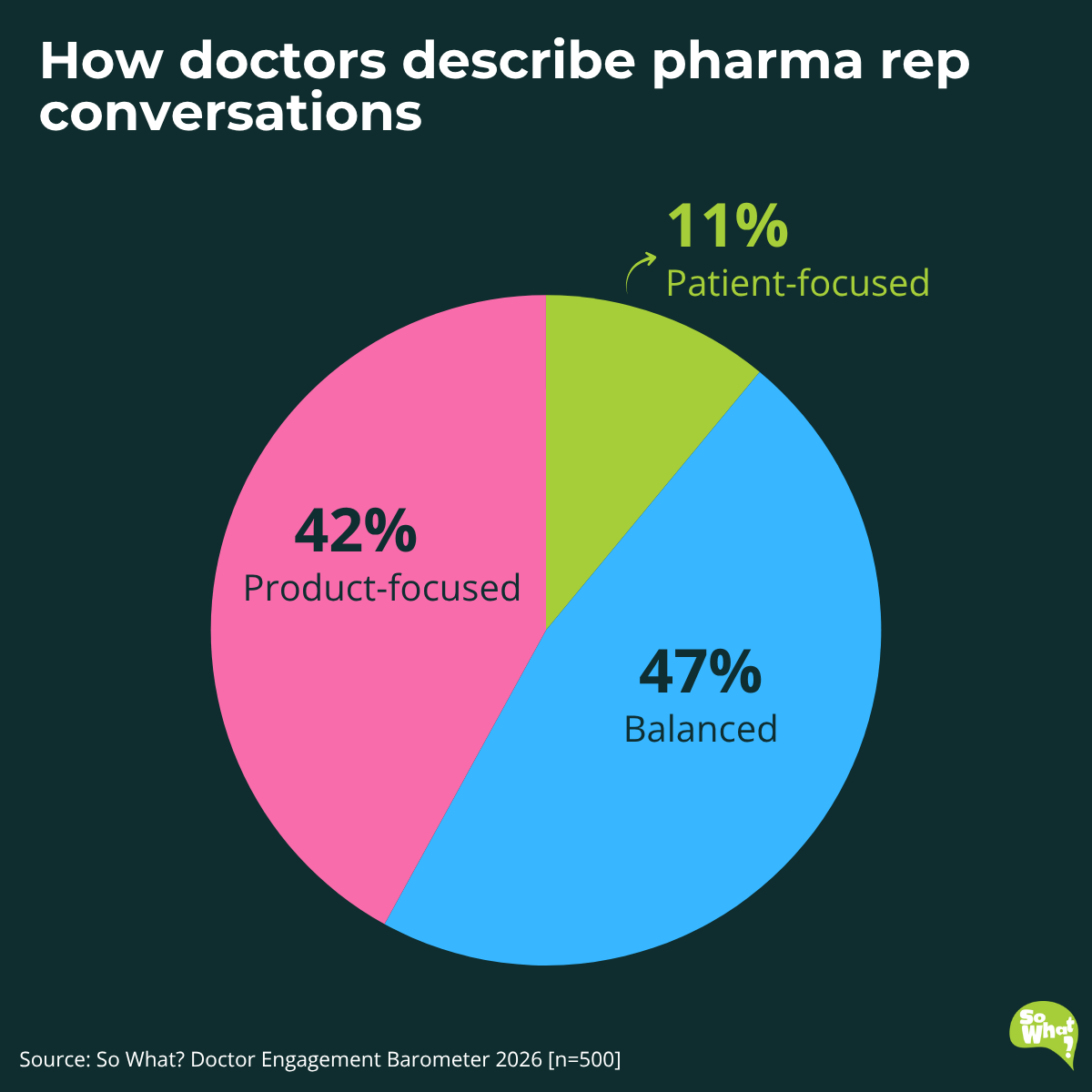
42% of Australian doctors say rep conversations are mostly about the product. That's almost four times as many as the 11% who say conversations mostly focus on their needs and those of their patients.
But what's the return when rep conversations become more patient-focused? And what do doctors want pharma to prioritise most?
In this article, we explore:
In our So What? Doctor Engagement Barometer 2026, we asked 500 Australian doctors about pharma rep conversations. 42% of doctors said they were mostly focused on product information and only 11% said conversations mostly focused on them and their patients’ needs: the “patient-focused” group discussed here.
The frustration with product-focused conversations was captured by one medical oncologist when explaining why their experience with pharma had worsened over the last 3-5 years:
"Pharma is now too focused on providing meaningless product updates, rather than focusing on how to support patient care." Medical Oncologist
Almost half (47%) described a balance between their needs and product information. This middle group is the opportunity. They already see some patient focus, and small changes in how reps run the conversation could move them further.
Patient focus is linked to greater perceived value of product rep visits. Doctors who experience mostly patient-focused conversations are almost three times as likely to rate product rep visits as ‘great’ at 35% versus 13% of doctors who describe conversations as mostly product-focused.
The difference extends beyond the value of the rep visit itself. Doctors in the patient-focused group are also almost three times as likely to say pharma strongly supports confident treatment decisions (38% vs. 13%).
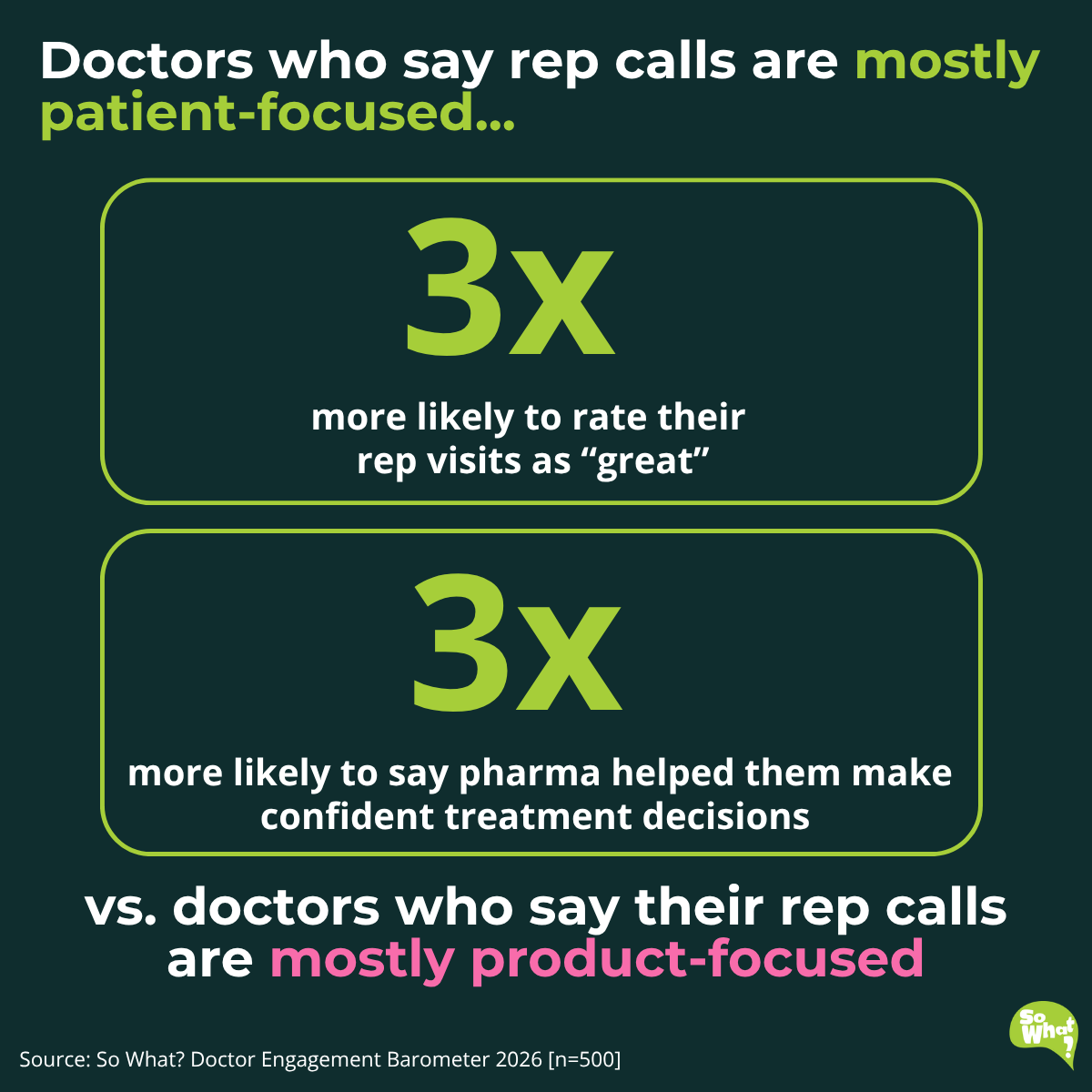
Together, these findings suggest that patient-focused conversations are associated with more valuable rep experiences and greater perceived support for clinical decision-making.
In practice, this means the opportunity is to help doctors apply product information to the clinical challenges they face and the patients they treat. Training and coaching can reinforce this by helping reps ask relevant questions, explore patient scenarios and connect the evidence to treatment decisions.
Product information matters most to doctors when it’s connected to the patients in front of them.
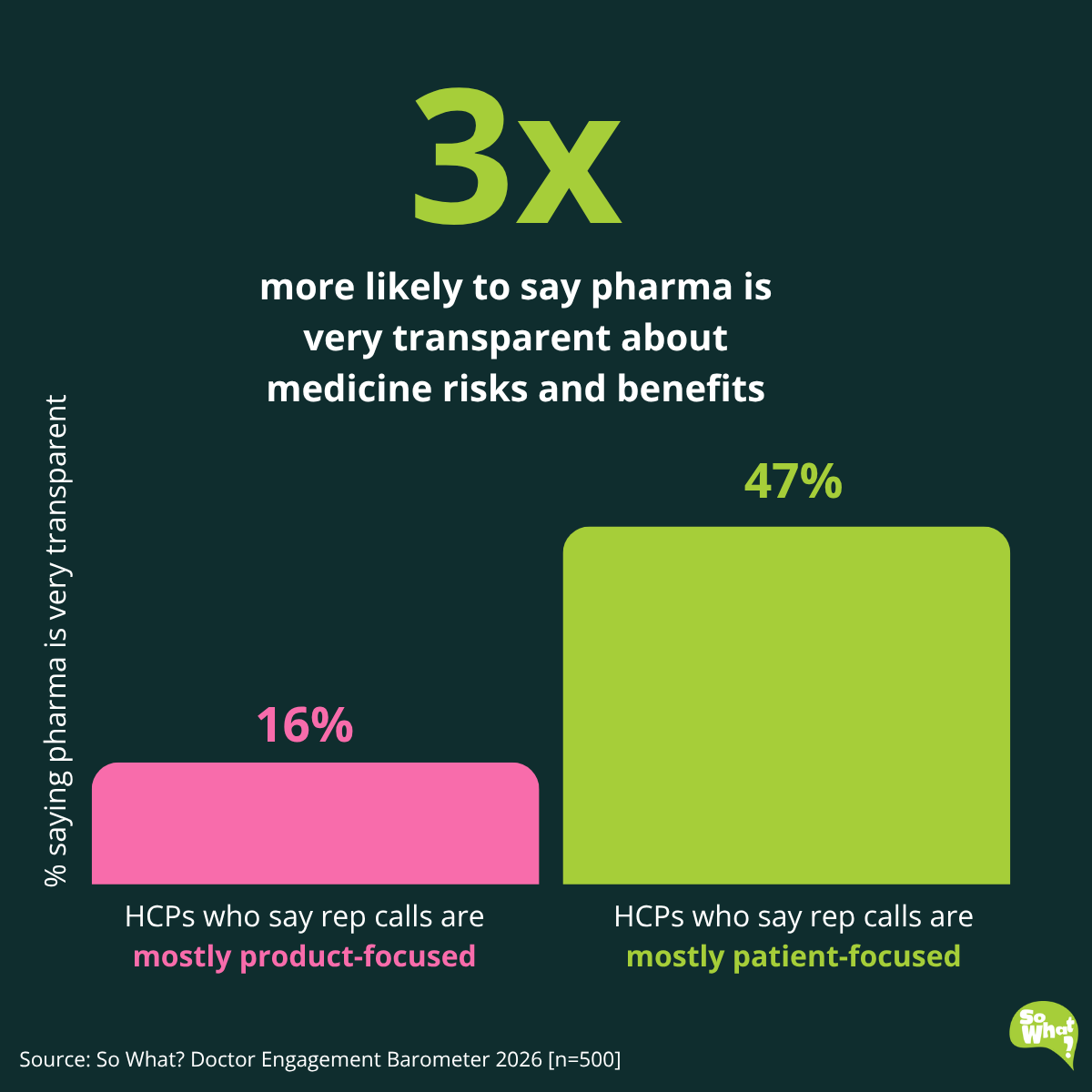
Patient-focused rep conversations are also linked to greater perceived transparency. Among doctors who describe conversations as mostly patient-focused, 47% rate pharma as very transparent about medicine risks and benefits, compared with 16% among those experiencing mostly product-focused conversations.
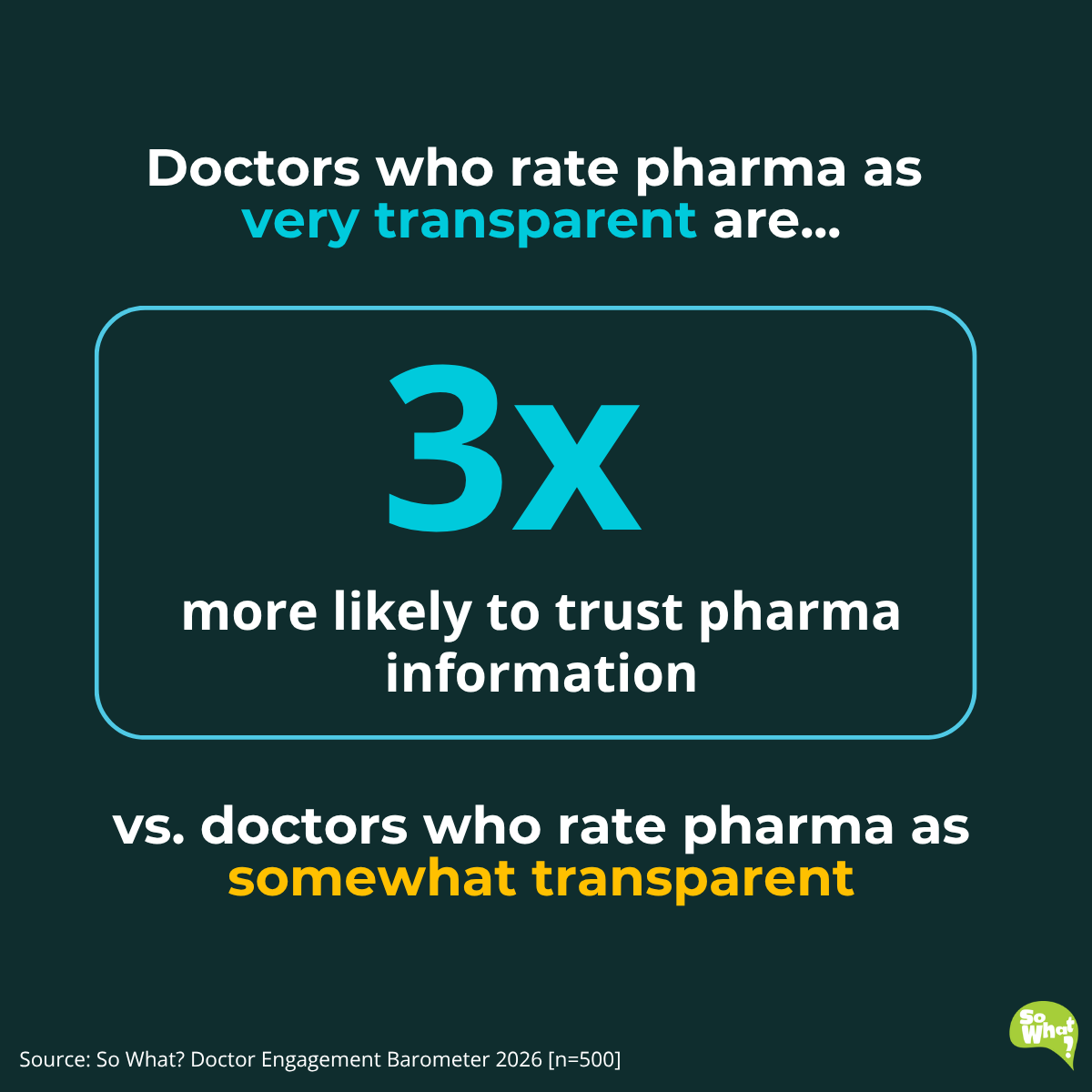
Transparency is closely linked to trust. Doctors who rate pharma as very transparent are almost three times as likely to trust its information compared with those who rate pharma as somewhat transparent (45% vs. 17%).
This reinforces the importance of providing balanced information about a medicine's benefits, risks and limitations. Doctors want to know where a medicine fits for their patients, and where it may not, as well as what it can do.
To build trust, transparency is key, and that means presenting the full picture of a medicine, not just its benefits.
When asked which areas pharma should prioritise to better support patient care, 60% of doctors included transparent information about benefits, risks and limitations in their top three. Transparency was also the number one priority, chosen by 29%.
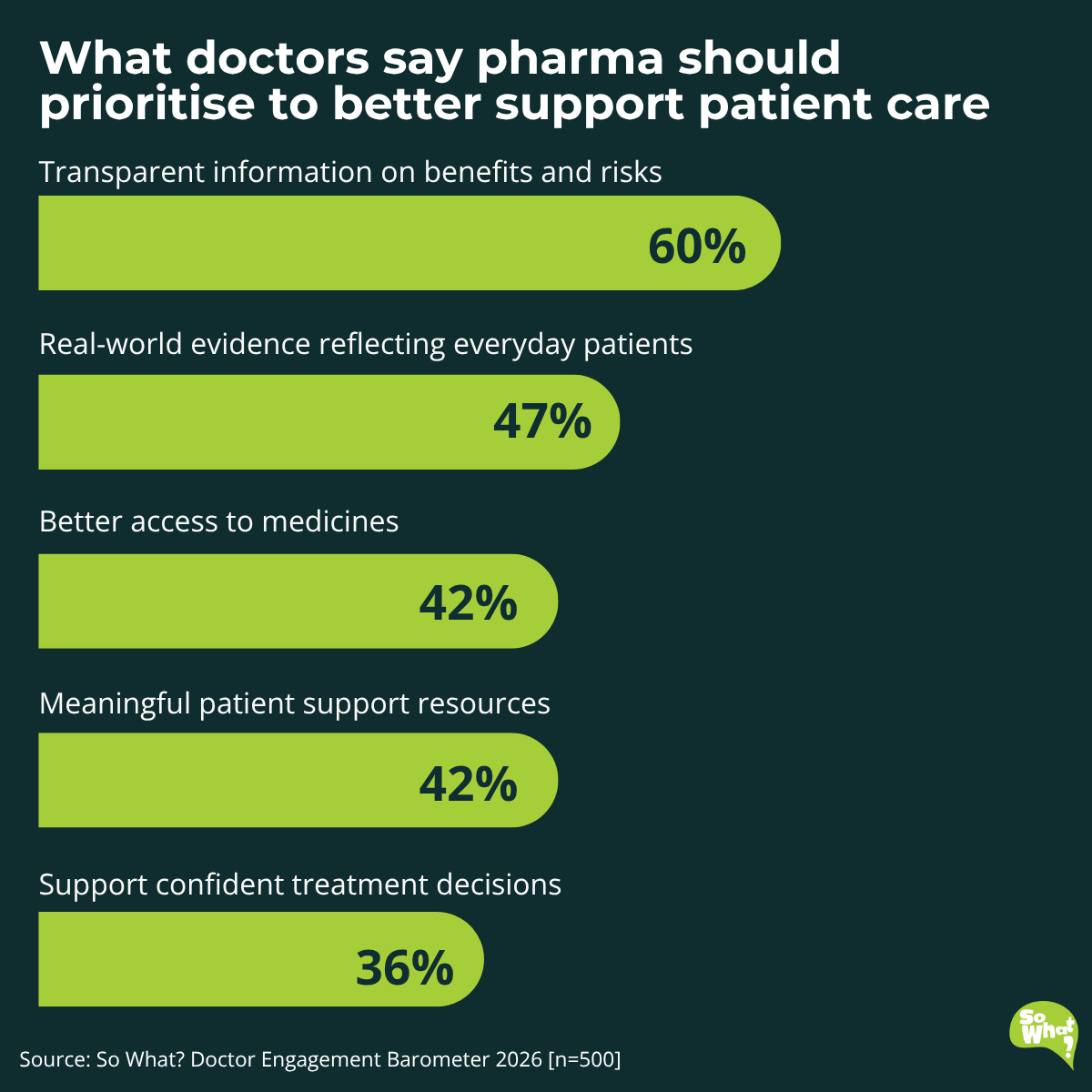
Real-world evidence reflecting everyday patients followed at 47%. Better access to medicines and meaningful patient support resources each attracted 42%, while 36% prioritised support for confident, well-informed treatment decisions.
Relevant real-world evidence, access information and patient resources can help make discussions more useful.
For field teams, the message is clear: connect evidence about benefits, risks and limitations to the treatment decisions doctors face.
Doctors want the full picture: benefits, risks, limitations and evidence that reflects real patients.
Patient focus is a familiar principle in pharma sales training. The challenge is making it consistently felt in consulting rooms and hospital corridors. Our findings suggest the return lies in how effectively reps connect product information to the doctor’s clinical challenges and patients’ needs.
1. Patient focus adds value to product conversations
Doctors experiencing mostly patient-focused conversations rate rep visits more highly and report greater support for confident treatment decisions than those experiencing mostly product-focused conversations. For field teams, the opportunity is to connect product information to clinical challenges and patient needs.
2. Transparency and trust go hand in hand
Doctors experiencing patient-focused conversations are almost 3 times as likely to rate pharma as highly transparent. Transparency is also closely linked to trust and is doctors' top priority for better patient care. This reinforces the importance of providing balanced information about a medicine's benefits, risks and limitations, rather than focusing only on its benefits.
Four actions for your 2027 field planning
1. Start with the patient, not the product
Encourage reps to understand the doctor’s clinical challenges and the patients they treat, then connect relevant product information to those needs.
2. Strengthen patient focus through training and coaching
Help reps ask better questions, listen closely and apply product evidence to relevant patient scenarios. Reinforce these skills through field coaching and feedback.
3. Make transparency part of every product conversation
Review how your teams communicate benefits, risks and limitations. Are doctors getting a clear picture of where your medicine fits - and where it may not?
4. Measure the experience, not just the activity
Alongside reach and frequency, track whether doctors find rep conversations relevant, useful and patient-focused, and how they rate visit value, decision support and transparency. Use the results to design training and coaching.
So What? Research can help pharma teams understand how doctors experience their pharma rep conversations, whether engagement feels patient-focused and transparent, and where there are opportunities to improve.
Our November article will explore patient access programs: their strategic importance and why fixing them should be on pharma’s priority list for 2027.
These insights come from The So What? Doctor Engagement Barometer 2026 - an independent national online study of n=500 Australian doctors including n=250 specialists across 20+ specialties. The research explores doctors’ experience with pharmaceutical companies. Data was from December 2025 to February 2026.