Pharmaceutical company engagement with doctors has traditionally focused on information delivery. This includes clinical data, trial evidence, and educational support. On these measures, the industry continues to perform strongly.
However, when engagement is assessed through the lens of practical usefulness, performance drops by approximately 30 percentage points. This is what we call the ‘value gap’ in doctor engagement.
These findings come from the So What? Doctor Engagement Barometer, a new survey of n=500 Australian doctors, evenly split between GPs and Specialists. The survey, now in its fourth year, explores how doctors assess the value of pharmaceutical company engagement across information quality, delivery, and practical support.
In this article we explore:
Where pharma support performs strongly and where it drops
What type of support matters most to doctors
Where the competitive advantage lies
Doctors increasingly evaluate pharmaceutical engagement through a simple question: does it make clinical practice easier?
How doctors rate pharma support
In our survey, we asked doctors how pharmaceutical companies support their clinical practice.
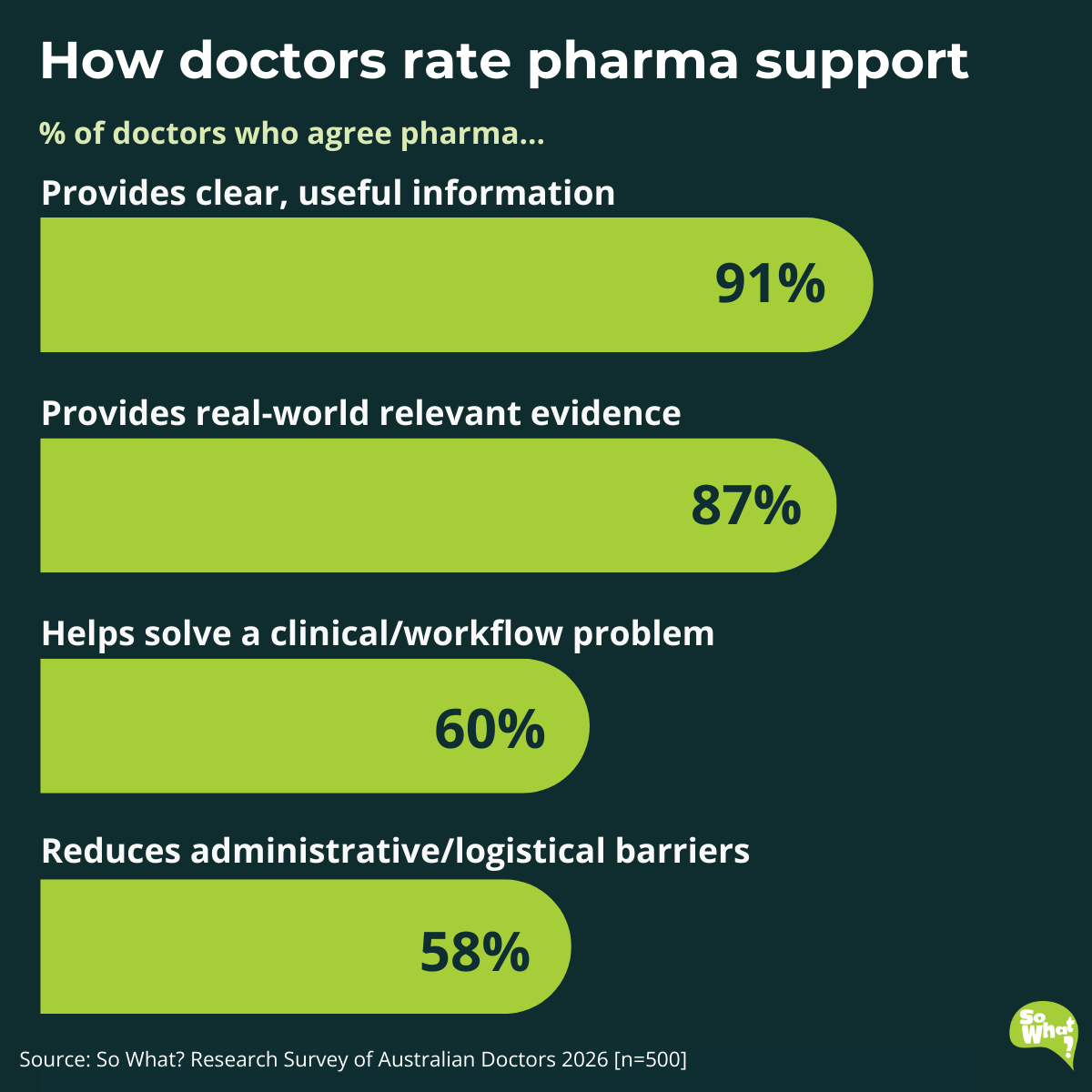
The results show a clear pattern. Pharmaceutical companies are rated highly for providing information and evidence, but less strongly when doctors consider whether engagement helps solve practical problems in clinical practice.
Most doctors agree that pharma provides clear, useful information (91%) and real-world relevant evidence (87%). These are strong results and reflect the industry’s continued focus on scientific communication and evidence generation.
However, ratings fall when engagement is assessed through the lens of practical usefulness. Around six in ten doctors say pharmaceutical companies help solve a clinical or workflow problem (60%), and 58% say they help reduce administrative or logistical barriers.
This 30-percentage point gap highlights the difference between informational value and practical value in pharmaceutical engagement.
In open-ended responses, doctors describe practical support as help with navigating treatment access pathways, providing starter packs or device demonstrations, supplying patient education materials, and clarifying reimbursement or prescribing processes.
How this varies by specialty
The experience of practical support is not the same across specialties.
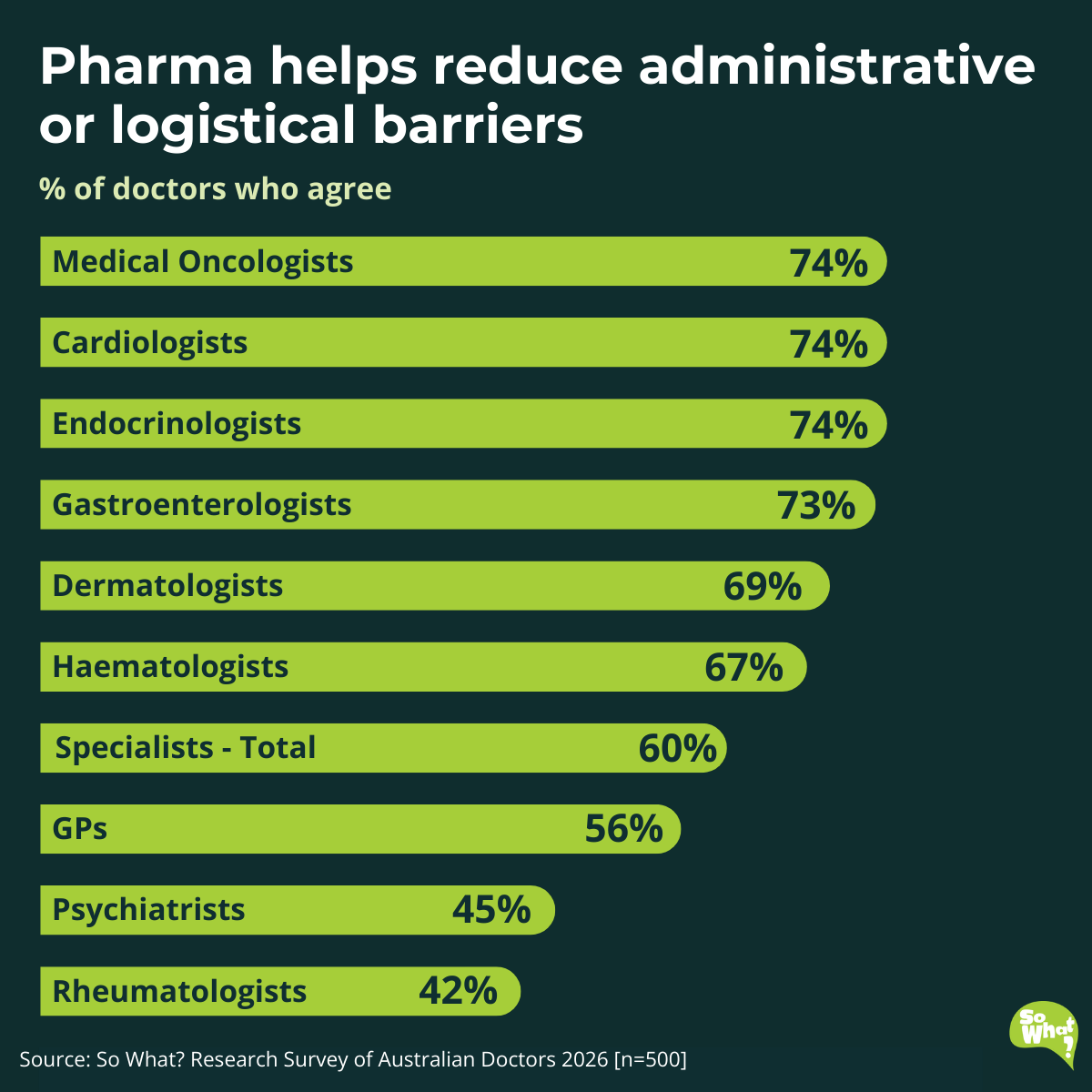
Medical oncologists, cardiologists, endocrinologists, and gastroenterologists are among the most likely to say pharmaceutical companies help reduce administrative or logistical barriers, with around three-quarters reporting this benefit.
GPs, psychiatrists, and rheumatologists are much less likely to say the same.
This variation suggests that the perceived value of pharmaceutical engagement depends not only on the support provided, but also on the operational realities of different clinical settings.
Why practical support matters more
In therapy areas where clinical evidence between brands is often comparable, the day-to-day experience of working with a pharma company becomes more important.
Any support that reduces friction in daily tasks and operations carries real value. Information helps clinical decision making, practical usefulness relieves burdens on time, staff, systems, and patients.
This is not about expecting pharma to solve the healthcare system, but about identifying the friction that sits adjacent to your product, access pathways and patient journey, and reducing it intentionally in an MA Code-compliant way.
This may involve simplifying access pathways, helping practices start patients on therapy more easily, or equipping clinicians with materials that make patient conversations faster and clearer.
Companies that remove everyday friction create a different kind of relationship. Not louder. Not more frequent. But easier to work with.
So What?
The 30-point value gap does not suggest pharmaceutical companies are performing poorly. Doctors continue to recognise strong performance when it comes to information and evidence.
The opportunity lies in practical usefulness. Doctors increasingly value support that makes clinical practice easier.
Before embarking on structural changes, it is critical to understand how doctors in your category currently experience engagement, and where friction sits in their daily practice, administration, and patient care.
Now What?
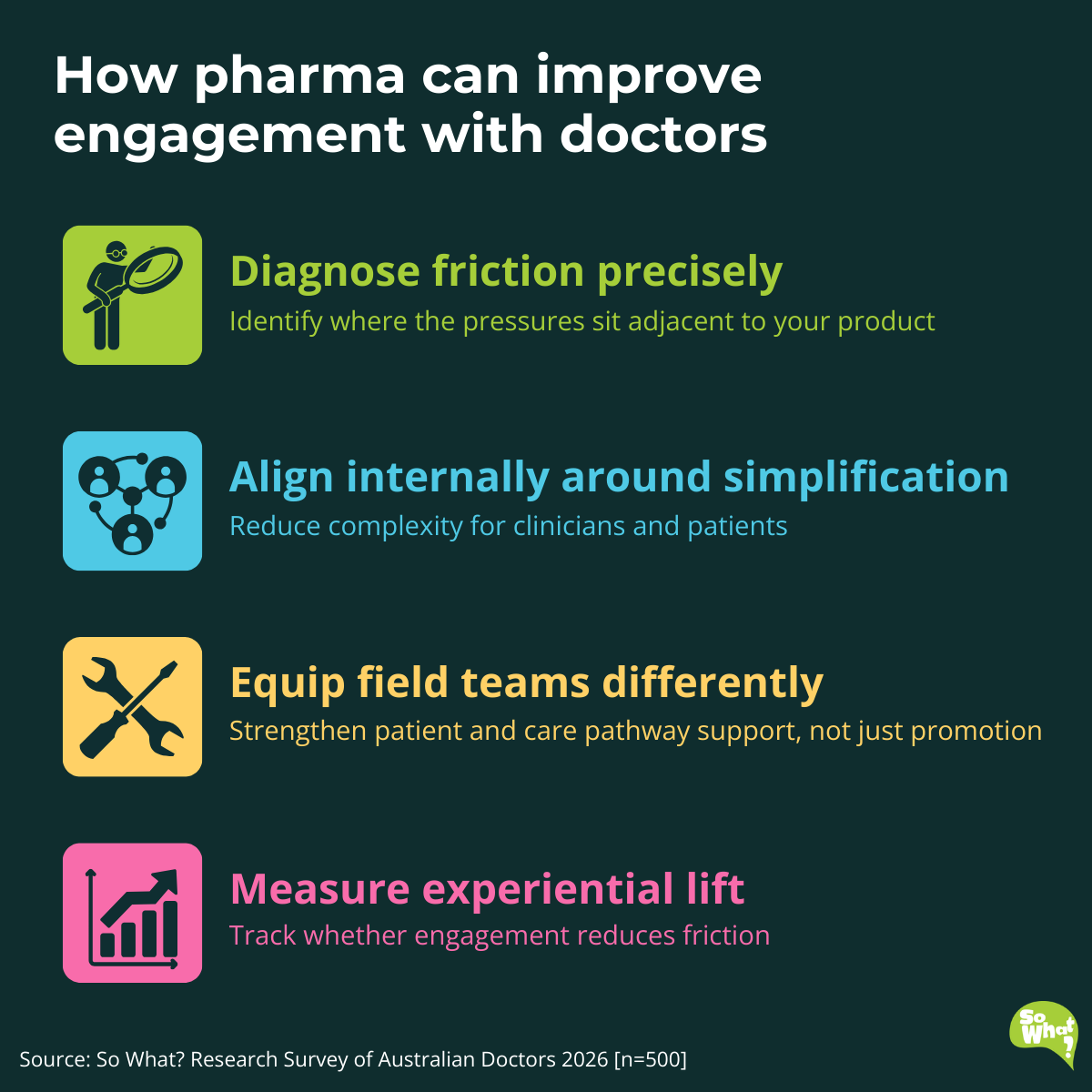
If doctors value support that makes clinical practice easier, four shifts follow:
Diagnose friction precisely
Identify the administrative, access and workflow barriers that surround your product in clinical practice. Distinguish systemic issues from those you can influence.
Align internally around simplification
Coordinate across medical and commercial teams to reduce external complexity. Internal fragmentation often amplifies external friction.
Equip field teams differently
Move beyond data delivery. Strengthen patient and care pathway support in ways that make practice easier and support Quality Use of Medicines.
Measure experiential lift
Track whether engagement reduces friction, not just whether activity increases.
The shift is not about increasing activity. It is about making engagement easier for doctors to navigate.
How we can help
So What? can help translate these industry insights into category and brand specific understanding. Through targeted research with doctors, we can help identify where the value gap exists in your market and how your company can become a more valued partner in patient care.
If you would like to explore how these dynamics apply within your therapy area or customer segment, we would welcome the conversation.
Next month
In our April article, we examine whether doctors believe pharma engagement has improved, deteriorated, or stayed the same over the past five years, and why.
About these findings
Insights come from The So What? Doctor Engagement Barometer - an independent national online survey of n=500 doctors (n=250 GPs and n=250 specialists across 20+ specialties). The survey explores how doctors experience and engage with pharmaceutical companies. Data was collected Dec 2025 – Feb 2026.
Was this article useful?
Thank you! Your submission has been received!
Oops! Something went wrong while submitting the form.
.svg)