



96% of medical oncologists say pharma should prioritise improving access to medicines to better support patient care.
But what happens when the very programs designed to help patients access medicines are hard for specialists to use?
We asked 250 Australian specialists about their experiences with pharma product access programs. Where do they get stuck, and what can pharma do to make these programs easier to use?
In this article, we explore:
Half of Australian specialists (50%) say pharma should prioritise improving access to medicines to support patient care.
But the proportion varies widely by specialty.
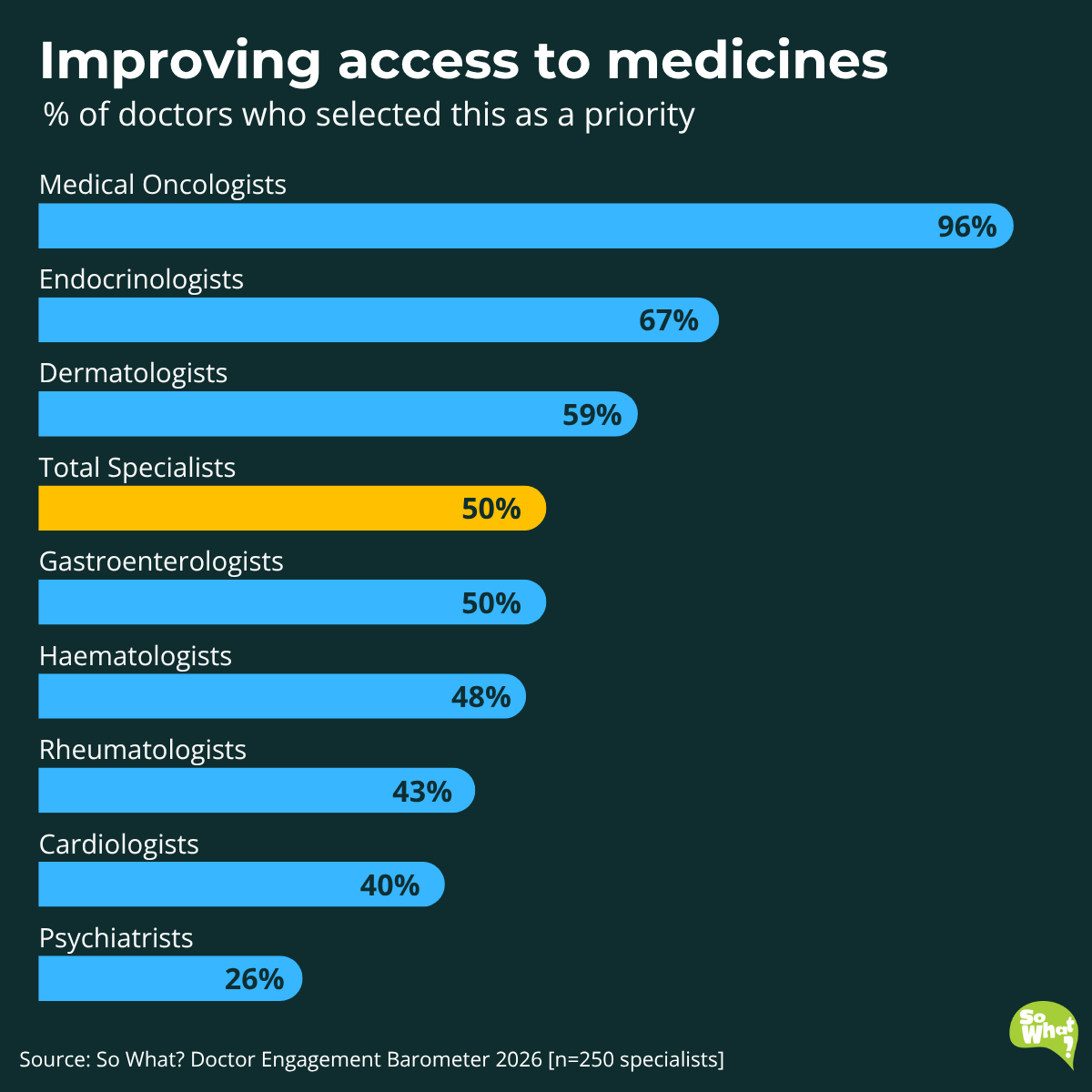
Medical oncologists were by far the most likely to select it as a priority (96%), followed by endocrinologists (67%) and dermatologists (59%). Cardiologists (40%) and psychiatrists (26%) were among the least likely to select it.
When patients need a medicine they can’t access through the PBS, a pharma product access program can offer one route to treatment. That raises a practical question for pharma. When specialists turn to these programs, how easy are they to use, and where do they run into difficulties?
An access program can help patients get treatment and still create unnecessary work and frustration for specialists.
Understanding which parts of the process cause the most difficulty in each specialty can help pharma decide what to fix first.
Specialists across several specialties described three recurring frustrations with the way access programs are run.
Complicated portals
"Improving compassionate access portal. They are different for each company which makes things very complicated and tedious. A country wide common portal would help" - Haematologist
Repeated approvals
"Allow compassionate applications be granted for 6 months like the PBS scripts rather than just 1 dose at a time" - Gastroenterologist
Too much red tape
"Give us earlier drug access via access programs and minimise the red tape in the access programs" - Medical Oncologist
Pharma companies can address many of these frustrations directly by simplifying applications, reviewing how often approvals need to be renewed and cutting unnecessary paperwork.
A medicine can be available through an access program and still be hard to get to a patient.
Your access program may sit with a different team. For a busy specialist, applying for product access is as much a part of dealing with your company as a visit from your rep.
A specialist can think highly of your medicine and your MSL and still dread using your portal.
A hard-to-use access program can shape how doctors see your company and, in some cases, whether they pursue access to your medicine for a patient.
Improving access to medicines is a priority for many specialists. Where an access program offers a route to treatment, how it runs shapes doctors’ experience of your company.
1. Access programs shape the doctor experience
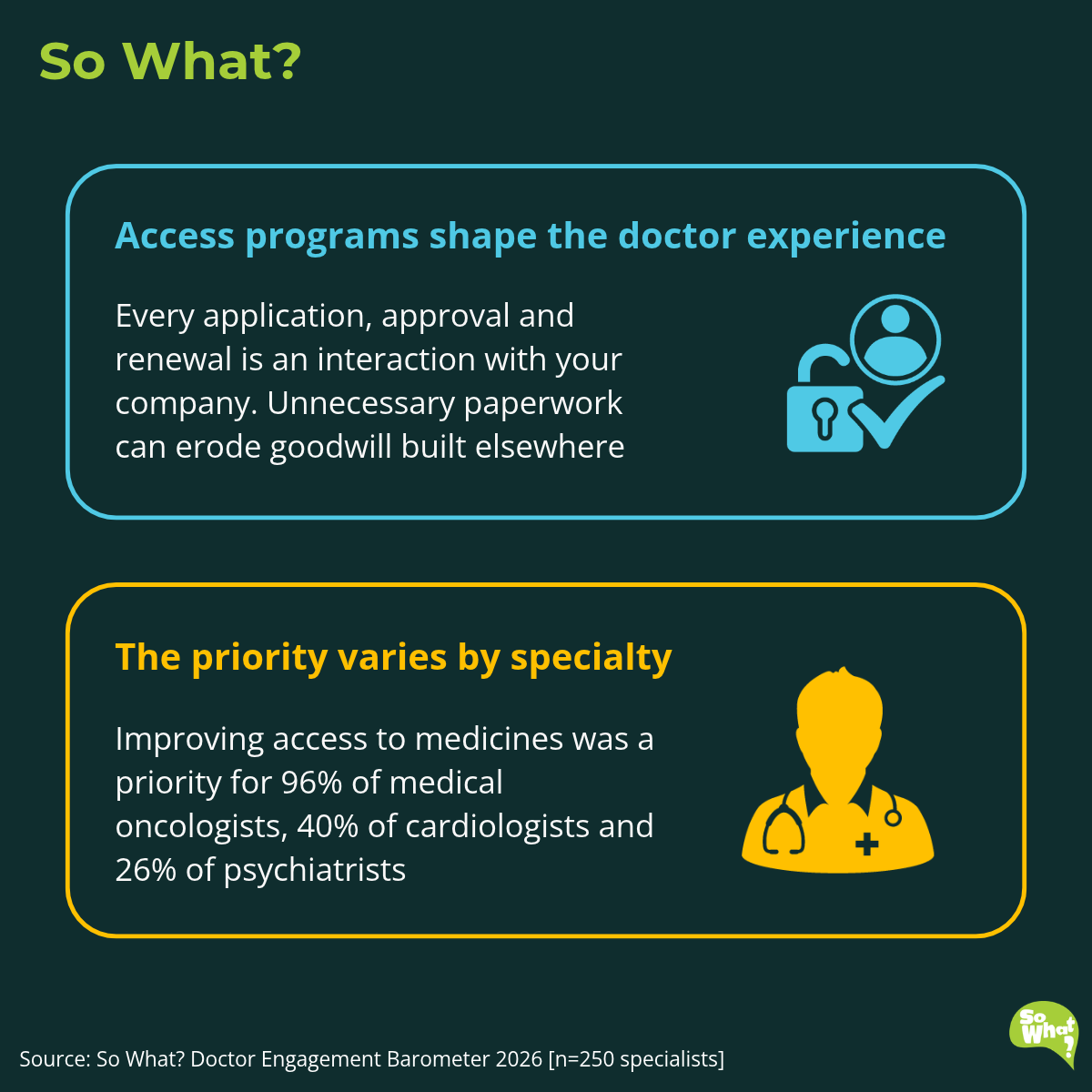
Access programs are part of how doctors experience your company. Every application, approval and renewal shapes that experience. Unnecessary paperwork can erode goodwill, even among specialists who value your medicines and clinical support.
Simplifying applications and renewals gives specialists less paperwork to manage as they work to get medicines to patients. It’s one of the most direct ways to show that your commitment to patient care extends to how you run your programs.
2. Improving access to medicines is a higher priority in some specialties
Almost all medical oncologists (96%) selected improving access to medicines as a priority for pharma, compared with 40% of cardiologists and 26% of psychiatrists.
Where you offer an access program, ask specialists who use it which steps cause the most difficulty and what would make the process easier.
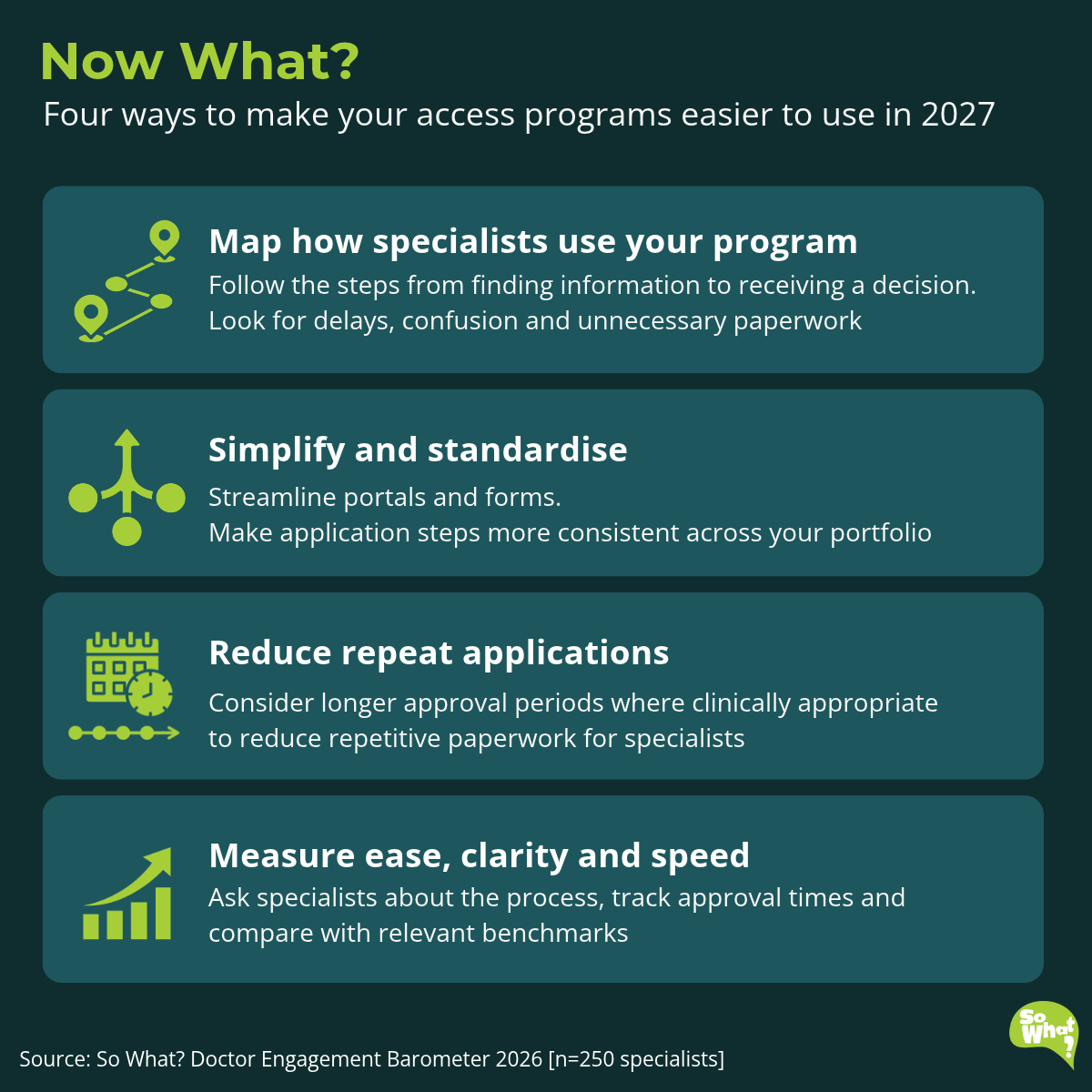
Four practical steps to make your access programs easier for specialists to use in 2027.
1. Map how specialists use your program
Follow the steps a specialist takes, from finding program information and checking eligibility to applying and receiving a decision. Identify where delays, unclear instructions or unnecessary paperwork slow them down.
2. Simplify and standardise processes
Review your portals, forms and approval requirements. Remove unnecessary steps and make the application process more consistent across your portfolio where you can.
3. Reduce repeat applications
Review how often specialists have to reapply for patients already on treatment. Where clinically appropriate, consider longer approval periods to reduce repeat paperwork.
4. Measure how easy your access programs are to use
Ask specialists to rate how easy it is to apply and how clear the requirements are. Track how long approval takes. Where comparable data are available, use other programs or industry benchmarks to identify where yours could improve.
Through tailored qualitative and quantitative research, we help pharma teams understand how specialists experience their patient access programs, benchmark that experience against comparable programs and identify what to improve first.
We’re planning next year’s research and would love your input. What would you like to understand better about healthcare professionals, patients or consumers? Responses are anonymous.
These insights come from the So What? Doctor Engagement Barometer 2026, an independent national online study of 500 Australian doctors, including 250 specialists across more than 20 specialties. The study explores doctors’ experience with pharmaceutical companies. We collected the data between December 2025 and February 2026.